
Why Was Berlin Divided: A Local History Lesson
Sep 18 2023
Meet Martin, a certified Berlin Tour Guide, with a PhD focused on German history - and a long and interesting history himself! Like many of the expert local guides on ToursByLocals, Martin is an absolute fountain of knowledge when it comes to his city's history. We asked him today for a little history lesson to explain why Berlin's infamous wall was built, to give you a taste of the sort of learning you can expect.
Why Was Berlin Divided? A Brief Lesson in History
As a tour guide, I often get asked why Berlin was divided in the first place and why, as a result, the infamous wall was built, a wall that would last for altogether 28 years. To answer the question we have to go back to the year 1945. Germany had lost the war which it started with the invasion of Poland on September 1st 1939.While the second world war was still raging, a number of conferences took place, the most notable of which were the Teheran Conference in 1943 and the Yalta Conference in February 1945. By then, US soldiers had already liberated most of France, including Paris and were about to cross the Rhine river. By January 1945, the Red Army had liberated Auschwitz, which led to a gradual awakening of the monumental scope of the atrocities committed by the Germans. By April, the Red Army stood on the outskirts of Berlin which it fully conquered by the month's end.
During the Teheran and Yalta Conferences, three allies - the US, the UK, and the USSR - had already started to discuss what to do with Germany once it was fully defeated. That it would be defeated became increasingly clear after Hitler's army was conquered and pushed back at Stalingrad in the winter of 1942/ 43.
The next and final conference took place at Potsdam, a city near Berlin, after Germany had unconditionally surrendered on May 8th, 1945, a declaration that was signed by all divisions of the Wehrmacht.
At the Potsdam Conference the allies agreed on a whole range of "de's" that were supposed to be implemented in a defeated Germany, including decentralization, democratization, denazification, demilitarization plus the split of Germany into four occupied zones: the British, the American, the Russian sectors, plus, as a concession to General De Gaulle's Forces Francaises Libres who successfully fought alongside the Allies in North Africa, a French one, too. The treaty also stipulated that Berlin, as the erstwhile capital of Nazi Germany, was to be treated separately, receiving a so-called "special status", which granted all 4 allied forces free movement in all 4 sectors of the city.
Between summer 1945 and summer 1948, the four sectors existed side by side, in more or less peaceful coexistence. But once the 3 Western allies agreed to introduce a new currency in their sectors, including Berlin, with the aim to get the economy back on its feet, Stalin was angered, regarding it as a provocation which led to the literal blockade of West-Berlin's. The result was the air-lift, through which the western allies kept West-Berlin going for the duration of about one year.
With the introduction of the D-Mark in Germany's western sectors and in West Berlin, the ideological divide between East and West, or: Communism versus Capitalism, became not just more apparent, but also ever deeper: What became known as the Cold War started as the USSR - which had fought alongside the US, the UK, and France during WWII - went from ally to foe.
By summer 1949 the blockade ended with the founding of West Germany or, as it is officially called: the Federal Republic of Germany (FRG) as a new state, covering the 3 western sectors. A few months later, the Eastern Bloc responded by founding East Germany, correctly called the German Democratic Republic (GDR), on October 7th 1949. Though it was factually a violation of the Potsdam Treaty, East Berlin gradually emerged as the Capital of East Germany. The West turned a blind eye to that, so as not to risk another escalation.
Though Germany as a whole, as well as the City of Berlin - which was situated smack in the centre of the Russian sector, in other words: the GDR - were each divided into 4 sectors, free movement was still possible. This went especially for Berlin which had special status. This relatively free movement, however, encouraged thousands of East Germany to flee to the West: By 1952, around 200.000 East German citizens had done so, even though crossing the border from East to West was actually punishable by law. But without effective border fortifications, there was not that much the East Germans could do. Howsoever, it prompted the East Germans to close the borders between East and West Germany in April 1952 by erecting strict controls, barbed wire fences, and the like, and by declaring the crossing of the border "Republikflucht" meaning the unlawful escape from East to West, and making it a punishable offense.
Nevertheless, this still left the city of Berlin as a loophole through which escaping to the West was still possible. As a result, in 1952 a refugee shelter was erected in the West Berlin district of Marienfelde, where East Germans were welcomed, issued with a new passport, given money, and eventually flown out to West Germany. Until summer 1961, about 2.5m East Germans took advantage of this option, which, by 13th August 1961, led to the closing of the borders between the Russian and the Western sectors, thus not only making an escape from East to West practically impossible, but also violating the Potsdam Agreement, which, after all, granted free movement to all Allied soldiers and diplomats.
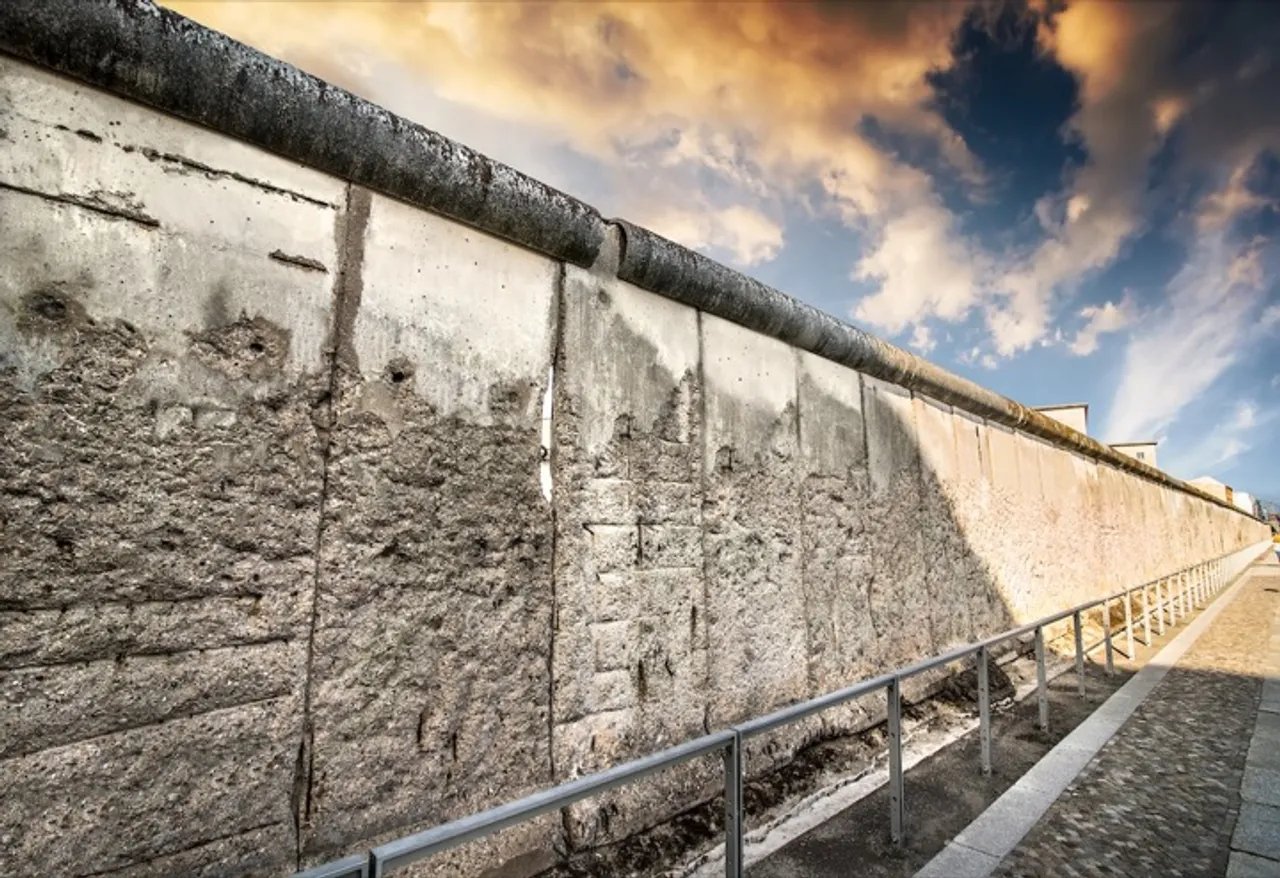
To somehow honour the Potsdam Agreement, the East German Interior Ministry declared Checkpoint Charlie the official border control through which allied military personnel as well as diplomats were allowed to pass. On 15th August the barbed wire, put down two days before, was replaced by a wall whose construction was closely watched and observed by members of the Stasi in order to prevent anyone from leaving the country illegally.
Over time, the border fortifications that became known to the world as the "Berlin Wall" grew ever more sophisticated. Instead of just one wall there would eventually be two, the first one, called interior wall, leading from East Berlin into the so-called death strip, as West Berliners referred to it, a literal waste land replete with signal fence and patrol ways for East German border control guards police and with more than 300 watch towers which, similar to the Wall itself, also grew taller and ever more threatening as the years wore on.
And though the Wall was built around West Berlin, it was of course, the East Germans who were literally imprisoned, as for West Berliners, there were still the transit highways, the trains, as well as airplanes to take them out of the divided city, a division which lasted for 28 years, until the 9th November 1989.