
Jewish History in Florence
May 21 2021
Each year, thousands of travelers want to learn more about Jewish influence and history in the places they visit. Some places take a bit more digging - and a guide who’s done their research. In Florence, Italy, for example, visual evidence of Jewish neighbourhoods is scarce, but the history is rich. Francesca, a local guide born and raised in Florence, shares a bit of information about Florence’s former Jewish ghetto - how it came to be, and how it came to disappear.
The Jewish Ghetto of Florence: where was it and how did it come to be?
“The ancient city center, from centuries-old squalor, to new life restored.” This pretentious inscription dominates the triumphal arch in Piazza della Repubblica (Republic Square), the place where the Mercato Vecchio (Old Market) and Florence’s Jewish ghetto once were. After Florence became the capital of the new Kingdom of Italy (1865-71), the government started a massive, revolutionizing city plan. In particular, the works regarding the Mercato Vecchio took place between 1885 and 1895. This period was celebrated as “Risanamento” (renovation), whereas the ones opposed to this major destruction called it “Sventramento” (literally, disembowelment).This renovation caused the demolition of many buildings with great historical and artistic value: medieval tower-houses, churches, guilds’ headquarters, noble palaces and artisans’ workshops. This operation was presented by the authorities as indispensable to renew a dangerous district, due to very poor sanitary conditions (even subjected to cholera, as the press reported), but in reality it was a mere real estate speculation. The most important victim of this urban project in Florence was the Jewish ghetto, which was demolished right down to the last stone.
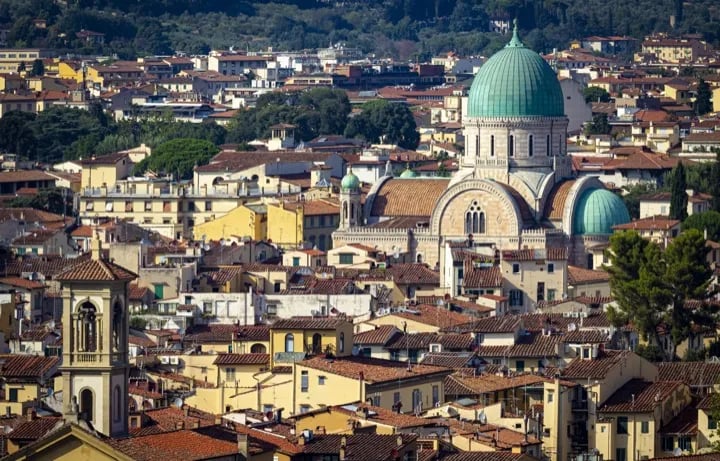
For this reason, there is nothing left today of the Jewish ghetto of Florence, unlike those in Rome and Venice, where one can still see, if not the whole, at least a considerable part of them. The community today attends the grandiose 19th century synagogue of via Farini, in a residential area of Florence called piazza D’Azeglio, completely uprooted from its original historical context. This might be the first reason for the scarce historiographical interest in the Jewish ghetto of Florence. After all, with the visual evidence erased, I am sure most of you didn't even know that one existed in the first place!
In 1570, when the Jewish ghetto of Florence was still a hybrid plan, there were already ghettos in three other Italian cities: Venice, Rome and Ancona. The Republic of Venice created its Jewish ghetto in 1516, the first one in the world, for simple commercial reasons, with no interference by the church. The word “ghetto” actually derives from the Venetian word “geto", which indicated the area of the lagoon where the Jewish merchants used to live. In that neighborhood there were several foundries where metal was cast, “geto” in the Venetian dialect. From the geographical connotation, the word “geto” started to indicate the Jewish neighbourhood.
Furthermore, “geto” sounded very much like the Jewish word “ghet”, meaning divorce: so the ghetto was, metaphorically, a sort of divorce of the Jews from the Christians. Nevertheless, the Church had a central role in the institution of all the other ghettos in Italy. The ghetto of Rome was built in 1555 by Pope Paul IV, together with the ones in Bologna and Ancona, following the papal bull (a sort of public order) Cum nimis absurdum, which revoked all the rights of the Jewish community. In 1569 Pope Pius V evicted the Jews from the ghetto in Bologna, forcing them to move into the one in Rome. He also invited all Christian kings to strictly divide Jews from Christians with another papal bull Romanus pontifex, through the construction of separated areas of the city where the Jews had to reside, and through the imposition of a yellow badge to wear on the garments. Cosimo de’ Medici was the first one to comply, making the ghettos in Florence (1571) and Siena (1572). Around the mid-17th century, almost the entire Italian Jewish population lived in the ghettos.
There’s so much more to learn about Jewish history in Florence and other Italian cities. Guides like Francesca have centuries of history at the ready, and can answer both big and small questions about Jewish history and heritage in Florence and beyond. Have a look at her Private Jewish History Tour for the next time you’re visiting Italy.